Why we need decolonial teaching to fight climate change
Climate colonialism “forces a re-embodiment and relocation of how, why and who is at fault/responsible. The climate is failing to change. It is being colonised and forced to alter, modify, and – as catastrophes indicate – it is rebelling and resisting the assault upon it” (Doreen Martínez, 2014).
Viewed through the lens of Sustainable Development Goal (SDG) 13 on climate action, this quote is a critique of climate colonialism. Martínez is saying that responsibility for the climate crisis is being displaced onto the communities and countries that contributed least to the crisis, while Global North actors retain the authority to define both the problems and solutions.
In this sense, the climate’s continued instability is framed as a protest against the dominant approaches that are attempting to control it through the same unequal structures that helped produce it.
This hierarchy of power and knowledge, often shaped and dictated by higher education institutions, controls the narrative about what we know and believe about climate change.
As a result, the information available to decision makers, researchers and students to make climate responses more innovative and impactful is vastly limited worldwide.
To change this, the global higher education sector must invest more in climate literacy through teaching and learning focused on decolonial climate pedagogy. This will allow for a comprehensive dialogue that can influence how current and future generations understand what climate solutions exist and how they can help those most affected.
Researching a decolonial approach
To better understand how decolonial climate pedagogy might be reflected in higher education, a research project was undertaken drawing on the International Association of Universities (IAU) SDG 13 Global Cluster, a network of lead and partner universities within the IAU Global Cluster on Higher Education and Research for Sustainable Development which collaborates on initiatives related to climate action.
The Cluster was used as a possible site of decolonial climate pedagogy. Specifically, the study investigates the University of the West Indies (Fiji), the lead institution of the SDG 13 Cluster, and the University of Nairobi (Kenya), an SDG 13 Cluster partner.
Publicly available website materials were reviewed to identify documented climate-related teaching and learning activities. These findings were supplemented by a short qualitative survey distributed to institutional representatives to clarify practices that may not have been publicly documented.
The survey asked respondents to describe their institutions’ principal SDG 13 teaching and learning activities, assess the extent to which these activities incorporated decolonial pedagogy, and explain how South–South partnerships influenced the activities and the challenges encountered.
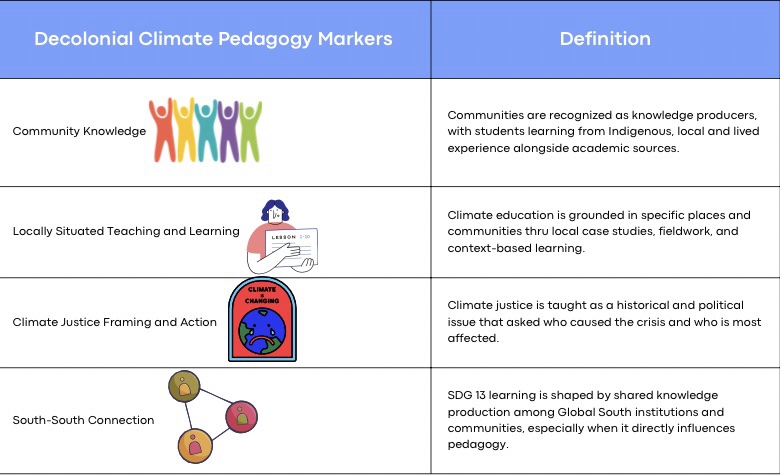
The evidence gathered through both sources was then examined using the specific decolonial climate-pedagogy-markers of community knowledge, locally situated teaching and learning, climate justice framing and action, and South-South forms of peer learning.
Decolonial climate pedagogy markers
Definitions of the markers were derived from a variety of academic literature sources.
Teaching and learning
Teaching and learning, while not a marker, refers to activities where climate-related knowledge is intentionally taught or developed through courses, programmes, workshops, training, student projects, fieldwork, curriculum initiatives, online modules, certificates or community-based learning.
Community knowledge
Climate learning recognises communities as knowledge producers, not just beneficiaries or research subjects. This can include various forms of Indigenous knowledge, local ecological knowledge, etcetera.
It can also involve community members serving as co-teachers, guest speakers or local experts. It should be evident that students learn from community experience, not only from
academic or policy sources.
Locally situated teaching and learning
Climate education is grounded in a specific place or community rather than taught only as a global or abstract SDG issue. It can look like fieldwork, local case studies, community-based learning and courses focused on local climate vulnerability.
Climate justice framing and action
Climate change is taught as a historical and political issue shaped by colonialism, not only as a technical environmental problem. This includes activities that ask who caused the crisis and who is most affected.
South-South connection
South-South connections are important because countries in the Global South often share related histories of unequal development and thus common goals. That said, these partnerships aren’t inherently decolonial and need to be examined for internal hierarchies.
A South-South connection refers to evidence that SDG 13 teaching and learning is shaped by shared knowledge production between universities, educators, students or communities in the Global South. In this project, it is only when the connection influences pedagogy that it matters most.
Project analysis
The University of the West Indies showed strong evidence of locally situated teaching and learning and climate justice framing and action. Its climate courses focus on Small Island Developing States and connect climate learning to Caribbean development priorities.
The programme also refers to reparatory justice, historical exploitation and the disproportionate climate burdens experienced by poor and vulnerable groups.
The University of Nairobi also showed strong evidence of locally situated teaching and learning but weaker evidence of climate justice framing. Its Master of Science in Climate Change is grounded in Kenya’s National Climate Change Response Strategy and Kenya Vision 2030. It addresses national climate priorities and the sociopolitical dimensions of climate change.
However, the programme does not explicitly frame climate change through colonial histories or unequal historical responsibility.
Community knowledge was weak or unclear at both universities. UWI’s materials include courses with references to community-based projects and solutions shaped by those most affected. However, they do not treat community members as teaching partners. Nairobi includes fieldwork and visiting lecturers but does not clearly treat community knowledge members as partners in student learning.
Evidence of South-South teaching and learning connections was difficult to identify at both UWI and Nairobi. UWI leads a cross-regional SDG 13 consortium and participated in an online course with the United Nations Development Programme, Performance Management and Delivery Unit (PEMANDU), Associates of Malaysia and the Caribbean Development Bank.
However, there is limited direct evidence of South-South collaboration through joint courses or collaborative learning. Nairobi’s Master of Science in Climate Change mentions the Kenyan and international community and credit transfer from other institutions but does not mention evidence of shared knowledge production between Global South institutions or communities.
In-depth analysis needed
Analysis of these markers within the University of the West Indies’ International School for Development Justice and the University of Nairobi’s masters programmes related to climate change indicated significant evidence of locally situated teaching and learning, as well as climate justice framing.
Publicly available information and survey information show that both universities are committed to grounding their programmes in the needs of their communities, while also teaching climate change as more than a purely technical issue, noting its historical and socio-political dimensions.
While there was substantial evidence of locally situated teaching and climate justice framing, evidence of commuity knowledge and South-South partnerships was more limited. While there were multiple mentions of community-orientated activities, there was no explicit evidence of community members directly shaping teaching or student learning.
In addition, while both universities have engaged in South-South or triangular partnerships, there is no evidence of explicit partnerships related to SDG 13 within teaching and learning initiatives.
Going forward, this research project would benefit from more in-depth analysis of course syllabiv as well as direct conversations with representatives at both universities.
It is important to note that the success of SDG 13 in teaching and learning is often assessed by UNESCO and other bodies primarily through institutional self-assessment and the presence of climate keywords rather than by pedagogical substance or justice orientation.
To engage more meaningfully with SDG 13, higher education institutions and global university collaboration initiatives such as the IAU HESD Cluster for SDG 13 should help pioneer shared qualitative indicators for climate justice, community knowledge, locally situated learning and reciprocal partnerships, while also supporting jointly taught courses and initiatives between Global South universities.
This approach will encourage other organisations to incorporate these dimensions into future assessment frameworks.
Ultimately, this research project emphasises the work needed within decolonial climate action through teaching and learning. This is a mechanism that is often neglected in SDG 13. However, it is the tool that best advances climate education by moving beyond interventions that reproduce the assault on our climate and help us toward solutions that respond to climate resistance.
Shrika Madivanan is studying for a Masters in Research and Innovation in Higher Education (MARIHE) through Erasmus Mundus and recently completed an internship at the International Association of Universities (IAU) with a focus on higher education and research for sustainable development.
This article is a commentary. Commentary articles are the opinions of the author and do not necessarily reflect the views of University World News.