Would a change of government relieve Israel’s embattled HE sector?
To say that Benjamin Netanyahu and his government have been unpopular among Israeli university leaders and senior academics in recent years would be an understatement.
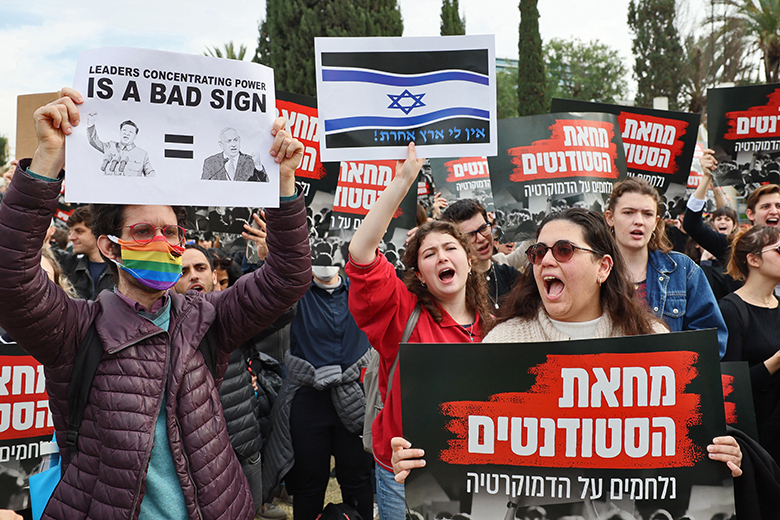
Netanyahu’s most recent prime ministerial term, during which he has governed in coalition with far-right nationalist and ultra-Orthodox religious parties, has seen the government accused by the Israel Academy of Sciences and Humanities of attempting an “unbridled political takeover” of the higher education sector. And university leaders have been prominent in the opposition to the government’s general political direction.
In March 2025 eight university presidents threatened to go on strike if the government carried out its intention to sack the country’s attorney-general (the sacking was enacted in August, but the decision was overturned by Israel’s High Court of Justice). And five presidents took the unprecedented step of writing an open letter to Netanyahu in July 2025 condemning the government’s “loss of moral restraint” in its actions in Gaza. The letter cited “the considered judgments of prominent legal experts within Israel and the international community” that calls from government ministers “for the intentional destruction of Gaza and the forced displacement of its civilian population” would “constitute serious violations of international law, amounting to war crimes and crimes against humanity”.
But whether the forthcoming Israeli general election on Tuesday (27 October) will change the country’s direction – and universities’ fortunes – is very much up in the air. The election is being hotly contested and could see Netanyahu, who has been Israel’s prime minister on and off for 19 years since 1999, ousted from office. But the polls currently put his right-wing nationalist Likud party neck and neck with Yashar, a centrist party led by the former Israel Defence Forces chief of staff, Gadi Eisenkot. And education has been low on a campaign agenda dominated by security, the fallout from the war in Gaza and the future of Israeli democracy.
Source:
Jack Guez/AFP via Getty Images
The five signatories of the Gaza letter were also among the nine of the country’s 11 university leaders to sign an open letter “to their international colleagues” in November 2023, in the wake of the 7 October massacre of more than 1,200 Israelis by Hamas. The letter decried “an alarming trend in which Israel, despite its right to self-defense, is mischaracterized as an oppressor” and that had seen “many college campuses [abroad] become breeding grounds for anti-Israel and anti-Semitic sentiments, largely fueled by a naïve and biased understanding of the conflict…Universities, as hubs of enlightenment and rational discourse, must take responsibility for the views they perpetuate.”
The 7 October attacks and the war in Gaza have had a strong impact on Israeli higher education in many ways. “Tens of thousands” – around a quarter to a third of Israeli students – are in the army reserves and have been drafted to fight in Gaza, according to Daniel Chamovitz, president of Ben-Gurion University of the Negev. Some 120 from his institution alone have died, and universities have been left to cope with the mental health of impacted students, with many suffering from PTSD and anxiety, he added.
But the indirect effects of the war are just as severe. According to David Harel, president of the Israel Academy of Science and Humanities, it has strengthened a pre-7 October push from the Netanyahu government to crack down on universities. Accordingly, the government has “carried out numerous steps against higher education and against academic research”, some of which have been “completely blatant”, Harel told Times Higher Education.
Chamovitz agreed, describing the current government as “clearly populist” – a stance that usually comes with antipathy towards universities. For instance, funding for higher education has dropped significantly in recent years amid wartime budgets and attacks on education, with no account taken of universities’ rising costs, he said.
But the “number one” problem for Israeli universities is “maintaining academic independence” amid increasing pressure from the government. “I would like [politicians] to leave us alone,” Chamovitz said. “The independence of higher education is critical.”
A recent academic paper, “Beyond the buzz: analyzing (re)politicization in higher education”, argues that Israel’s university system has, over the country’s short history, swung between “periods of depoliticisation to repoliticisation”, with the latter in the ascendancy since about 2010.
The paper cites numerous examples. One is an attempt in 2024 to require higher education institutions to dismiss employees deemed by Israel’s Council for Higher Education (CHE) – the country’s accreditation body – to have made statements that were supportive of terrorism or face financial penalties.
In another article published in the newspaper Haaretz in July 2024, Tel Aviv University president Ariel Porat said that the urge to crack down on terrorist support “may seem innocent enough, but two main features reveal its fascistic character and its aim to subjugate academia to government control”.
The first was that the bill “requires imposing severe punishment without a trial”. The second was that “the person who will interpret and implement the law in practice is a politician, the minister of education, who is the chair of the Council for Higher Education”. And there are ministers who are “quick to define completely legitimate statements as incitement to terrorism”, Porat added.
In such circumstances, “the head of the institution will have to choose between a bankruptcy of values – firing a professor who did nothing wrong – and financial bankruptcy due to the expected budget cut that would be imposed on the institution for disobeying the minister.” And he urged the government not to usher in “an academia plagued by McCarthyism. Universities are not the enemy. Without an independent academia, we will not be the same, whether in the humanities, in science, or in the strength of our security. I ask that you…deal with the truly acute and existential problems that we face, rather than with those that someone has fabricated out of thin air.”
What was dubbed the “Silence Law” passed its preliminary reading in the Knesset but still hasn’t been passed.

Source:
Erik Marmor/Getty Images
Just as controversially, however, the government did pass legislation this summer allowing universities to permit master’s and doctoral courses to be segregated by gender.
Yofi Tirosh, an associate professor in law at Tel Aviv University and campaigner against the law, argued that while the legislation is being presented as benefiting ultra-Orthodox students, whose religious views prevent them from studying with members of the opposite sex, it will actually harm them because they will receive a “second-rate education”.
“The faculty who teach them will be inferior, because there is not enough budget,” she explained. “Running a sex-segregated academic programme costs three times as much [as a non-segregated programme] because you need to pay three professors to teach the same class and pay overheads for three classrooms.”
In addition, “We know from experience with segregated programmes at the BA level that there is also censorship of materials that don’t fit ultra-Orthodox ideology,” Tirosh said. “For example, evolution, gay marriage, or Sigmund Freud. So the clients of these [graduates] in the therapeutic professions will receive inferior service and inferior treatments.”
The move has sparked fierce backlash in Israel, with a petition led by Tirosh receiving support even from ultra-Orthodox women. Several members of the CHE have resigned over the matter, even though the law merely permits sexual segregation, rather than mandating it.
In that sense, the law is not a major “slippery slope”, according to Yishai Fraenkel, vice-president for advancement and external relations at the Hebrew University of Jerusalem. But it is “yet one more red light that we’ve got to be cognisant of and – looking forward to the election and future government – hope…can be reversed”, he added.
The law was of a piece with other attempts to use student rights as “a pretext for imposing legislation which we define as politicised”, added Fraenkel, who is currently doing a PhD at Bar-Ilan University on higher education governance and politicisation, with Israel serving as “the empirical entry point”. His “Beyond the buzz” paper, mentioned above, goes as far as to say that “by reframing political intervention as student protection, politicians have found a highly effective, sector-specific angle through which to impose state rule over academic autonomy”.
Additionally, critics have raised concerns that the government has sought to use political appointments to the CHE to assert control over the sector. University representation on the body has collapsed from a majority of 67 per cent in the 9th Council, serving from 1997 to 2002, to only 29 per cent in the 14th Council, which was inaugurated in 2022, Fraenkel’s paper outlines.
Representation from Israel’s elite “Old Four” higher education institutions – the Technion – Israel Institute of Technology, the Hebrew University of Jerusalem, the Weizmann Institute of Science and Tel Aviv University – was cut nearly in half over that period, from 37 per cent to 19 per cent, underlining the “politicization of the ‘arm’s-length’ bodies”. On another of those bodies, the Planning and Budgeting Committee, Old Four representation had dropped to zero by 2023. And Fraenkel sees that as a deliberate attempt to diminish the power of a group “viewed by many on the hard right as left-leaning liberals” and as a “self-serving liberal elite”.
Fraenkel warned that if it remains on its current trajectory, “Israel may be in a position that is not so good in terms of academic freedom, [or] in terms of our ability as academics to carry out our job to go and do open research”. But he stressed Israel still ranks in the top 30 per cent of countries in the annual Academic Freedom Index compiled by political scientists at the Friedrich-Alexander University of Erlangen–Nuremberg – above the UK, France and the US.
“We’re very, very far from countries like Hungary,” he said, referring to the Orbán-era restrictions on academic freedom and institutional autonomy that have left Hungary languishing in the bottom 20-30 per cent of nations.

Source:
Nir Alon/ZUMA Press Wire/Reuters
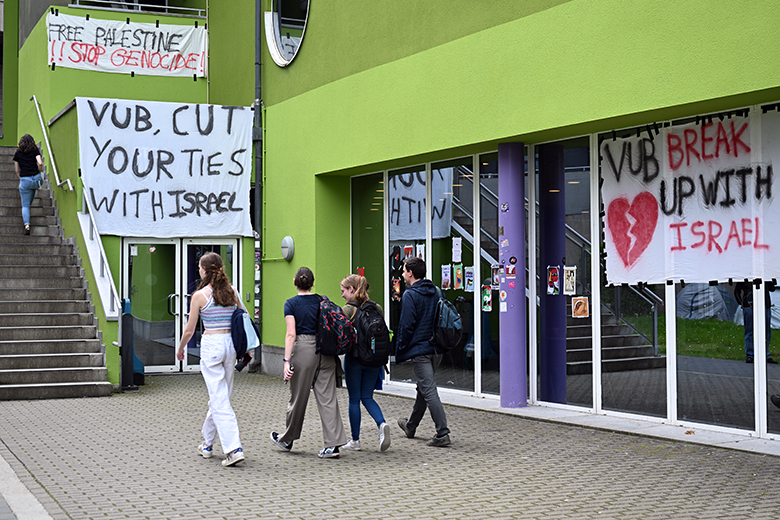
Nevertheless, Israel’s international reputation has suffered enormously in recent years, with boycotts of Israeli academia being imposed as the country’s actions in Gaza came increasingly to be regarded as disproportionate.
A report by the Global Students for Palestine Network found that between November 2023 and December 2025, more than 100 universities across the world participated in some form of academic boycott of Israeli universities, and 2025 saw a 68.5 per cent drop in approval rates for Horizon Europe proposals that included Israeli partners.
Contrary to their intentions, however, Chamovitz said the boycotts are serving Netanyahu’s coalition’s political position: “The truth of the matter is that by boycotting Israeli academia, you’re only helping the most extreme elements within my government, who are very happy for us not to collaborate with Europe.”
Either way, the boycotts, which are being targeted at both Israeli institutions and individual Israeli academics, are far from over and need to be considered a political priority, said the Israel Academy of Science and Humanities’ Harel.
He noted that Israeli universities are “still under consideration for getting thrown out of Horizon Europe by the European Union” owing to human rights concerns, which could inflict further damage on the country’s research sector. And that is why he feels obliged to keep speaking out about the war.
“If I criticise what is going on in Gaza, I criticise it because I’m a concerned citizen and I hate what’s going on. But my justification for doing so, particularly because of the fact that I’m president of the Academy, is because it’s directly relevant to Israeli science,” Harel said.
Source:
Dursun Aydemir/Anadolu via Getty Images
Addressing the country’s damaged reputation could also help with the wider issue of brain drain, he added. This has been a major issue in recent years, with the Central Bureau of Statistics finding in 2025 that about 12 per cent of those who attained PhDs in Israel were living abroad. That included more than 25 per cent of students with doctorates in maths and nearly 22 per cent of computer science PhD graduates who resided overseas.
“One of the most important things is to make serious efforts to bring Israelis back to Israel,” Harel said: “postdocs, scientists on sabbatical, engineers and medical doctors. If the country becomes a better place to live in, and good things happen and we have a good government, [that task] will be easier.”
But he worries that even if the election of a “really good and sane government” delivered funding increases for science and higher education and eased “attempts to control what’s [been done] by terrible ministers”, Israel’s global reputation “will take more time” to fix, meaning that boycotts could endure.
“Certain things are irreversible. Your typical professor of history or physics in the UK or in Spain or Germany will not change their opinion of Israel so quickly, and certain things have already happened. Collaborations have already been stopped and have disappeared,” he said.
Moreover, Annette Bamberger, a lecturer in higher education at UCL, worries that even if a new government reverses some of Netanyahu’s excesses, other legislative changes that universities object to have cross-party support. “So even if there was a radical change in the government, some of these processes might not be reversed,” said Bamberger, who was co-author, with Fraenkel, of the “Beyond the buzz” report.
Fraenkel agreed, comparing the situation to that of the US (which is now in the bottom 30-40 per cent in the Academic Freedom Index). “In the first Trump administration there was a high level of politicisation within the sector. Then you look at [Joe] Biden’s presidency: he did things that I think previous Democratic presidents would not do. Once norms are breached, or once there’s this tool chest on how politicians can meddle with the higher education sector, they then have this temptation.”
Harel described himself as an “optimist” – although that does “not mean sitting back and saying that everything will be OK”. And he reserves the right to switch to pessimism if Netanyahu wins again.
“I feel that if [the opposition] lose this election, it will be a death blow to…the democratic nature of Israel as we know it,” he said. And he remains concerned by the lack of public discussion of what that might mean for the country’s higher education and research sector.
“During this pre-election period in Israel no one is really talking seriously about these issues,” Harel said. “The problems of Israeli science and higher education do not cause a sufficiently loud bell to ring in the ears of the population.”