Has TNE become the future of internationalisation?
TNE can diversify risk, but it can also amplify it
Last summer, a survey found that 76 per cent of Russell Group universities had seen declines in international postgraduate applications, with an average decline of 16 per cent. This, of course, followed the UK government’s 2023 ban on master’s students bringing dependants: a major contributing factor to a financial crisis that has seen tens of thousands of job losses.
The weaker international affordability of UK degrees, rising geopolitical instability and the disruptions in the job market wrought by AI have only increased the difficulties of recruiting international students onshore – and enhanced the rationale to pivot to teaching them where they live through transnational education (TNE).
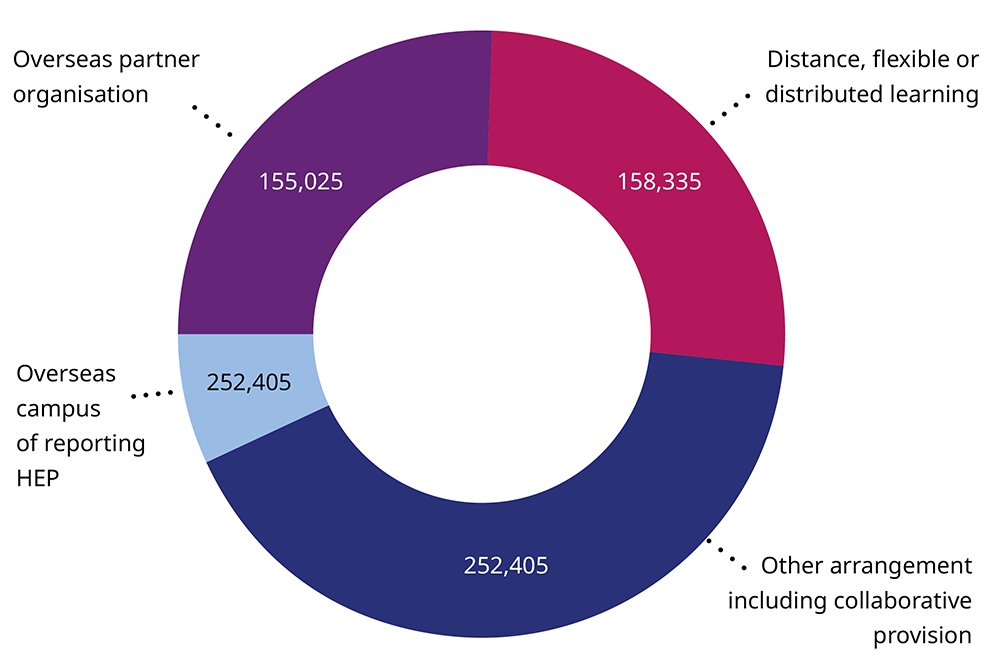
There are several types of TNE, from full overseas campuses to distance learning, collaborative provision and franchising arrangements. Collectively, more than 600,000 students were taught in this way in 2023 – 448,145 in-person and 158,335 via distance provision.
UK TNE student numbers by type of provision (2023)
Source:
HESA Aggregate Offshore Record
The most resilient TNE models are not simply “teaching somewhere else”. They build a local ecosystem: governance, employer links, faculty capability, credible progression routes, and student support. That kind of embeddedness is expensive – but it is also what makes the venture robust when policy or geopolitics shift.
The University of Nottingham’s branch campus strategy remains a benchmark. Its Malaysia campus, opened in 2000, and its China campus, opened in 2004, are deeply embedded operations – which matters when education is a trust-intensive service. China’s Ministry of Education has also approved 70 collaborative TNE projects involving UK and Chinese universities, of varying forms, levels of study, scales and disciplinary foci.
The UK is establishing full branch campuses in other geographies, too. Cardiff University Kazakhstan, a branch campus in Astana, opened last September, and numerous universities are responding to a government invitation to establish a presence in India.
TNE can diversify risk but it can also amplify it, and it is important to bear in mind that plenty of high-profile ventures have failed, been wound down, or never reached scale.
For example, UCL’s Qatar campus closed at the end of 2020, after a decade of operation. UCL’s Adelaide outpost was also wound down after a review in 2015. And the cautionary tale of the University of East London’s Cyprus campus, which closed after six months owing to poor recruitment, has become sector folklore for a reason. Institutional branding cannot compensate for poor market alignment and execution.
If universities want TNE to be more than a short-term revenue fix, they should stop thinking of it as “exporting degrees” and start thinking like multinational companies. International business research offers a practical lens here. John Dunning’s OLI framework explains why firms choose different ways of operating abroad: selling from home, partnering or investing directly. Applied to TNE, this becomes a straightforward set of questions – except that the objective is not only profit but also the protection of academic standards and institutional reputation.
- Ownership (O) advantages: That is, what we uniquely bring. What about the “home” university is portable overseas? Brand credibility? Pedagogy? Assessment integrity? Employability networks? Research reputation? Faculty development systems?
- Location (L) advantages: Where is student demand deep and durable? How stable are regulation and geopolitics there? What are the cost structures and language environments?
- Internalisation (I) advantages: Which aspects of the service must be controlled tightly to protect quality and legitimacy (presumably, admissions, assessment, academic governance and data integrity), and which can be shared safely with partners?
Seen through the OLI lens, many struggling TNE ventures reflect a classic multinational error: the entry mode chosen does not match the governance costs and reputational risk. For example, UCL’s ownership advantages (brand and research reputation) combine strongly with London’s location pull, such that 52 per cent of UCL’s 51,793 students were classified as overseas in 2024-25, and the institution cited an “extraordinary surge in demand” after exceeding its visa-sponsorship allocation.

Source:
Nature Picture Library/Alamy
Offshore branch campuses, by contrast, require heavy internalisation – replicating quality control and governance at distance – without equally reliable location advantages. For universities whose strongest O and L are anchored at home, “delivery” can end up substituting for, rather than complementing, onshore growth. The implication is that for somewhere like UCL, the “best” TNE strategy might be not to build overseas campuses at all, and instead to double down on its UK location – visa regulations permitting.
Nor should universities underestimate the challenges for governance and quality assurance posed by distance – cultural, regulatory, administrative and political. Entry mode choice is crucial: validation-style models may scale quickly but carry heavier reputational tail risk. Joint ventures can embed locally but expose you to partner politics; branch campuses offer more control but demand managerial depth.
The financial pressures are forcing UK universities into risk-taking behaviour, often without the governance capacity that international expansion requires. But if they strategically choose markets with durable demand, select entry modes that fit a high-trust service and internalise the controls that protect academic standards, TNE can be a route back to resilience – while asserting a global civic mission for British higher education.
Peng Zhou is professor of economics at Cardiff Business School and dean of international at Cardiff University. He is also director of Cardiff Confucius Institute, the Centre for China Business Research and the Welsh Institute for Research in Economics and Development. Dhanjay Jhurry is managing director of Uniciti International Education Hub.
Locally meaningful social and economic impact is vital
Transnational education is undeniably important to the Global South. When it comes to keeping pace with rapidly evolving fields such as artificial intelligence, health technologies and advanced manufacturing, universities there often face structural constraints such as limited resources and shortages of specialised expertise. And the quickest and most effective way to overcome those constraints is through well-designed international partnerships.
Through TNE, institutions in developing contexts gain access to academic expertise, curricula and teaching and research capacity that would otherwise take years, if not decades, to develop locally. Pathways open up for more young people to enter higher education: in Mauritius, for example, more than a quarter of students are enrolled in TNE programmes. And they benefit from internationally recognised qualifications without the financial and social costs of studying abroad.
However, the traditional model of TNE, characterised by relatively linear models that merely extend the reach of institutions from the Global North, is increasingly being rejected. Although branch campuses, franchised degrees and partnership arrangements have expanded access, they are no longer sufficient in a world defined by complexity, technological disruption and shifting geopolitical realities.
This conviction was frequently voiced at the recent International Conference on Transnational Education, organised by the Uniciti International Education Hub in Mauritius. Bringing together policymakers, institutional leaders and practitioners, the conference offered a timely opportunity to reframe global conversations on cross-border higher education through the lens of the Global South. The event highlighted that TNE is evolving into a strategic, fast-growing segment of the global higher education landscape and a platform for the co-creation of knowledge, talent and innovation across borders.
Increasingly, successful transnational initiatives are those that embed research collaboration, entrepreneurship and industry engagement from the outset. Education hubs exemplify this transformation. When effectively designed, these bring together universities, industry, government and communities within a shared environment that fosters talent development and knowledge exchange, connecting different levels of education and linking academic activity to real-world challenges.
The conference also highlighted the potential for inter-hub collaboration to enable new forms of mobility, joint research and shared innovation initiatives, creating clusters of expertise in areas such as sustainability and the United Nations’ Sustainable Development Goals.
Generating locally meaningful social and economic impact should be just as important to TNE as teaching programme delivery. And this is happening. Examples were shared during the conference of how TNE is supporting projects focused on environmental, social and governance developed with local authorities; student-led solutions to urban and societal challenges; and innovation and entrepreneurship centres linking academia and industry.
However, achieving this requires enabling conditions, including robust research infrastructure, institutional capacity and strong engagement with industry and government partners. At the conference, funding mechanisms were repeatedly identified as a critical constraint.
Technology can help, of course. Digital platforms and AI-driven tools are enabling new delivery models, expanding access and enhancing scalability. Yet a clear message from the conference was that technology cannot substitute for the human dimension. The success of TNE continues to depend on well-qualified academic staff, effective institutional leadership and thoughtful implementation.
At the same time, the growth of AI raises important questions about the future of work. As even degree-requiring jobs become more exposed to automation, TNE systems must evolve to ensure that graduates are equipped with the skills needed in an uncertain and rapidly changing labour market.

Source:
Wolfgang Kaehler/LightRocket via Getty Images
All this will take sustained institutional commitment from both TNE partners. Purely transactional relationships are no longer enough. One of the strongest messages to emerge from the discussions was the centrality to success of long-term, trust-based partnerships, built on shared values, mutual respect and aligned objectives.
Participants converged on key principles for effective partnerships:
- Two-way academic and knowledge flows
- Equitable distribution of risks and benefits
- Alignment with local contexts and development priorities
- Strong compliance with quality assurance frameworks.
As TNE expands, ensuring quality also becomes paramount. Conference delegates emphasised the need to balance robust quality assurance with regulatory flexibility, recognising that overly complex or duplicative systems can hinder innovation.
Encouragingly, new forms of cooperation between quality assurance agencies are emerging to streamline processes while maintaining standards. In Mauritius, recent agreements with international bodies such as the UK’s Quality Assurance Agency and France’s High Council for the Evaluation of Research and Higher Education were highlighted as important steps in strengthening credibility and reducing approval timelines.
Such developments are essential if TNE is to scale sustainably while preserving academic integrity and ensuring the international recognition of qualifications.
Perhaps most importantly, the discussions made one point unequivocally clear: the Global South is no longer merely adapting to transnational education. It is increasingly helping define it.
For a country such as Mauritius, strategically positioned between Africa and Asia, this represents a significant opportunity. By building strong partnerships, fostering innovation ecosystems and maintaining high standards, it can play a pivotal role in shaping global higher education.
Fabrizio Trifiró is programme director at the Education World Forum. Dhanjay Jhurry is managing director of Uniciti International Education Hub (UIEH)
A strategic lifeline – but no quick fix
International students contribute far more than tuition revenue. They enrich academic communities, strengthen research ecosystems, build long‑term cultural and diplomatic ties, and play a critical role in skill development and innovation.
But governments in the traditional “Big Four” destination countries have become increasingly ambivalent about it over the past two years. Concerns about immigration levels have prompted hostile rhetorical and visa crackdowns in the UK, Canada, Australia and the US alike.
At the same time, international higher education is being reshaped by forces that go beyond policy alone. Families weighing study options are making decisions in a world defined by heightened geopolitical risk, uneven economic recovery from Covid and a rapidly expanding range of credible alternatives. The question is no longer simply which of the traditional Big Four destinations to choose but whether long‑distance physical mobility is the right option at all.
Market intelligence increasingly points to diversification rather than simple displacement. Growth in international enrolment in destinations such as Malaysia, China, Thailand and Singapore reflects a broader recalibration of demand, driven by cost, employability, safety, migration rhetoric and perceptions of welcome. This is less a temporary wobble than a structural evolution in how international education is accessed and valued.
Against this backdrop, it is unsurprising that universities in the Big Four countries are turning to TNE. Indeed, it is being increasingly encouraged by governments in both host and source countries.
India’s National Education Policy, for instance, explicitly invites leading international universities to establish a meaningful in‑country presence, recognising the scale of unmet domestic demand. Kazakhstan and other emerging economies have been similarly receptive to institutions willing to invest seriously, partly as a means of reducing brain drain. The UK government’s own International Education Strategy now positions TNE as a vehicle not just for revenue generation but for soft power, diplomatic influence and long‑term economic partnership.
But over more than two decades of working in and around TNE, I have seen many Western universities under financial pressure jump in with the wrong expectations. TNE will not rescue an institution next year. Success demands operational maturity, cultural intelligence, robust academic governance and, above all, a genuine commitment to collaboration.

Source:
Erich Thielscher/McPhoto/ullstein bild via Getty Images
Partnerships built on unequal foundations eventually fail. Institutions that feel treated primarily as recruitment pipelines disengage or underperform. Partners in India, Nigeria, Indonesia and beyond are increasingly explicit about what they want: collaborations grounded in shared purpose, mutual investment and genuine academic exchange.
This is why approaches such as the Equitable TNE Progression Model that I have developed deserve serious attention. This focuses on postgraduate progression pathways that allow local institutions to retain and strengthen their undergraduate provision. A Partnership Development Fund, built directly into the financial architecture, ensures that a proportion of international student fees is reinvested into joint research, curriculum development, faculty mobility and scholarships.
Equity in partnership design must be matched by a high‑quality student experience. Quality assurance frameworks that exist only on paper eventually produce outcomes that harm students and institutions alike. The same is true of programmes that don’t align with the economies students will graduate into and that don’t meaningfully connect graduates to employers.
This is where validation partnerships are often undervalued. When done well, validation enables genuine co‑development: programmes shaped by local industry insight but delivered to international standards, with rigorous academic oversight. The result is not a transplanted curriculum but something distinctive, relevant and sustainable.
When these elements are missing, financial losses are not the only risk. Reputational damage is another – and in TNE reputational harm travels quickly and can sully international perceptions of entire national sectors.
But pursued strategically – with senior leadership ownership, dedicated resources and a realistic time horizon – TNE represents one of the most powerful opportunities available to universities serious about transforming lives through education. It takes the university to the student, without requiring families to assume the financial, geopolitical and personal risks associated with overseas study. In many contexts this is not a second‑best option to overseas study but the preferred one.
The conditions for thoughtful, strategic TNE have rarely been more favourable. But begin with the mission. Build equity in from the outset. Resist the temptation to treat TNE as a quick fix. That is the only version of TNE worth doing.
Charles Cormack is chairman of Cormack Consultancy Group, which has worked with more than 1,000 universities on TNE since 1999.